The four Cs.
Four measurements that let two diamonds be compared honestly. They are not a ranking of beauty and they will not choose a stone for you — but knowing what each one describes, and which of them you can safely spend less on, is most of the work.
Cut. It does more than the other three together.
Clarity, once the stone is clean to your eye.
Colour — on the metal you set it in.
Cut
How well the stone was made — and the only C that is a human decision rather than an accident of geology.
On a fancy shape, read the table and depth percentages and the length-to-width ratio instead — and then look at the stone.
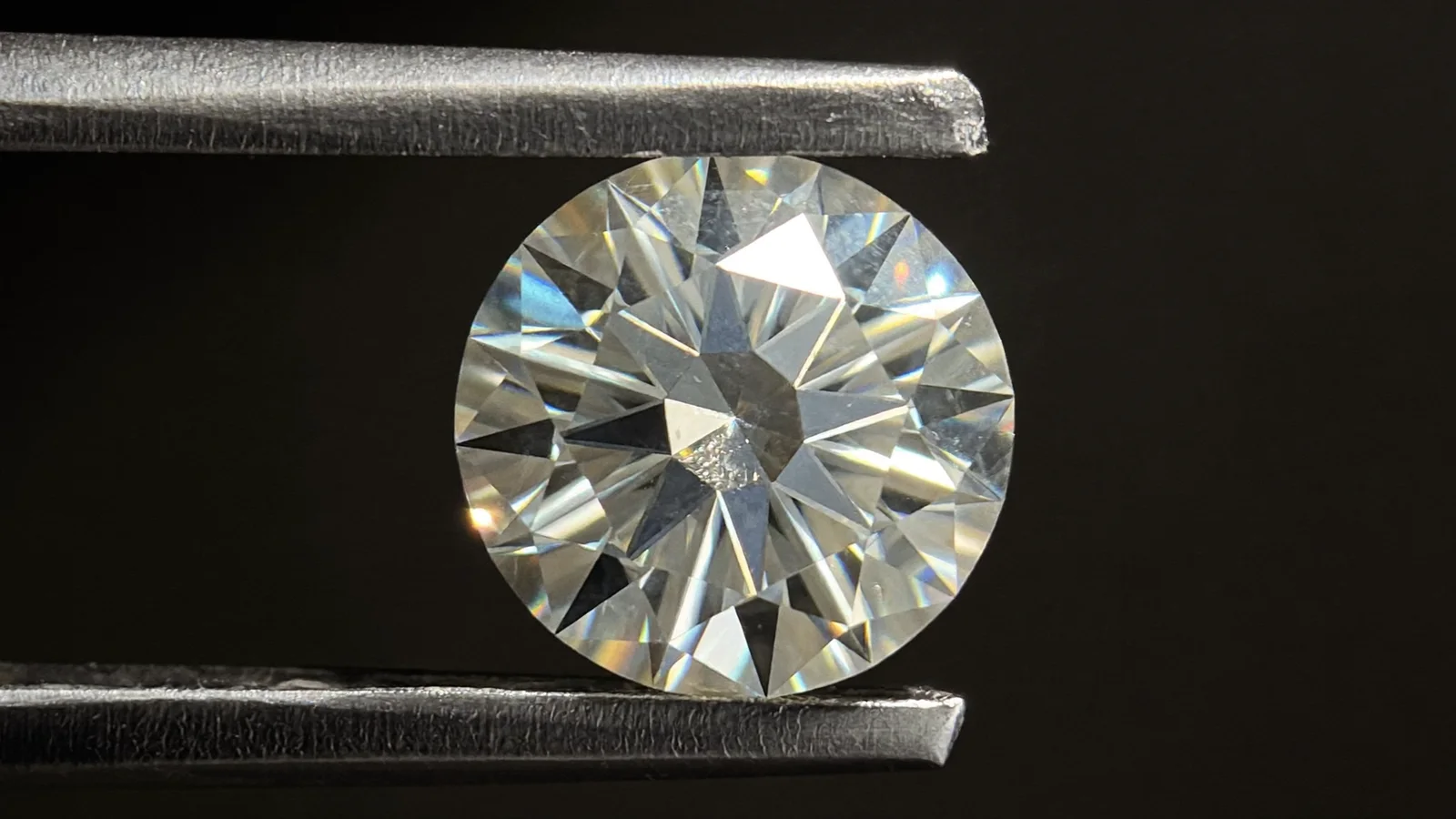
A diamond returns light because its facets are cut at angles that bounce light back through the top. Cut too deep and light escapes out of the bottom; cut too shallow and it leaks out of the side. Either way the stone looks flat, whatever the rest of the report says.
The cut grade collapses proportions, polish and symmetry into one judgement. It exists only for standard round brilliants, because they are the one shape with agreed proportions to grade against.
Ideal through Good, as we list it.
Colour
How little colour there is. The scale runs from D, colourless, down through progressively warmer tints.
D–F is colourless, G–J near-colourless. Below about H the warmth starts to show face-up in a white metal.
Grading is done face-down against a masterstone set, under controlled light, by people trained to see differences that are genuinely subtle. Face-up, in a ring, on a hand, most of those differences disappear.
What does not disappear is the interaction with metal. A warm stone in yellow gold looks deliberate; the same stone in platinum can read as slightly dirty. Choose the metal first and the colour grade second.
D through K, the range we stock. The tints are the body colour of each grade.
Clarity
What formed inside the crystal as it grew, and how easily it can be seen under 10× magnification.
From VS2 upwards inclusions are almost never visible without magnification. Paying past that buys a certificate, not a look.
Almost every natural diamond contains something. The grade records how large those inclusions are, how many, where they sit and how visible they are to a trained grader with a loupe — not to you across a dinner table.
Which is why the useful threshold is not a letter but a question: is it clean to your eye? That is usually met somewhere around VS2 or SI1, and where the inclusion sits matters more than the grade. An SI1 with a feather at the edge can be a better buy than a VS2 with a crystal under the table.
Flawless through SI2, as we list it.
Carat
Weight, not size. One carat is 0.2 grams — and two stones of the same weight can look quite different.
A 0.95 ct and a 1.00 ct are indistinguishable on a hand. On an invoice they are not.
Weight can be hidden. A stone cut deep carries more of its mass below the girdle, where nobody sees it, and faces up smaller than its weight suggests. A well-spread stone of the same weight looks larger. This is why the measurements in millimetres are the more useful line on a report.
Prices also step, rather than climb smoothly. The jumps sit at the round numbers — 0.50, 1.00, 1.50, 2.00 — because that is where demand concentrates. Just below each of them is where the value is.
Face-up diameters for a well-cut round brilliant, as a rough guide. The measurements on the report are the figures that count.
Where to spend,
where to save.
Any budget forces a trade. This is the order we would make it in, and it is the same advice we give across a table.
The only grade that describes workmanship rather than luck. It governs how much light comes back out of the stone, and no other grade can compensate for it.
Above that grade you are buying something you cannot see without magnification. Find the lowest grade that is clean to your eye and stop there.
In yellow or rose gold a warmer stone reads as intentional. In platinum or white gold the warmth shows, so it is worth going a grade or two higher.
Prices step up sharply at 0.50, 1.00, 1.50 and 2.00 carats. A 0.95 looks like a one-carat stone on a hand and costs meaningfully less.
Asked about
the four Cs.
Cut, and it is not close. It is the only grade that records how well the stone was made, and it decides how much light comes back to your eye. A well-cut stone a grade lower in colour and clarity will outperform a poorly cut one that reads better on paper.